
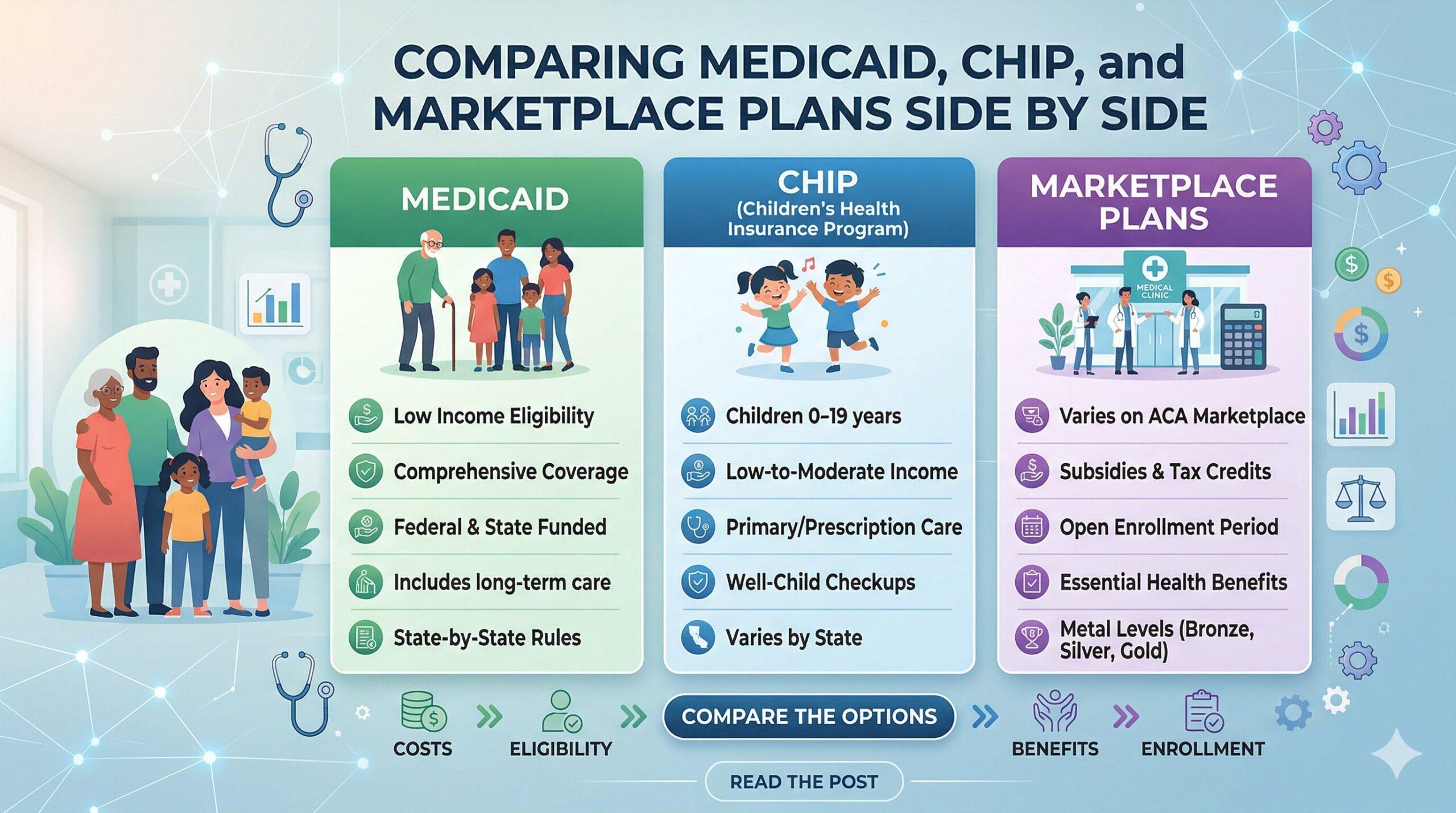
If you are looking for health coverage and you do not have it through an employer, three options come up almost immediately: Medicaid, the Children’s Health Insurance Program known as CHIP, and marketplace plans purchased through the Health Insurance Marketplace. All three exist to make coverage more accessible, but they serve different populations, have different costs, and work in fundamentally different ways. Knowing the distinctions helps you figure out which one actually fits your household situation right now.
How Medicaid and CHIP Work
Medicaid is a joint federal and state program that provides free or very low-cost health coverage to adults and families with low incomes. Since the Affordable Care Act expanded Medicaid eligibility, most states now cover adults earning up to 138 percent of the federal poverty level. Coverage is comprehensive and typically includes doctor visits, hospital stays, mental health services, prescription drugs, and preventive care. There are no monthly premiums in most states for people who qualify, and cost-sharing is minimal. Eligibility is based on current income, so you can apply at any time of year, not just during open enrollment.
CHIP is specifically for children in families that earn too much to qualify for Medicaid but cannot afford private insurance. In most states, CHIP covers children up to age 19 in families earning up to 200 percent of the federal poverty level, and some states set that threshold even higher. The program covers routine checkups, immunizations, emergency care, dental and vision services, and prescriptions at very low or no cost. Like Medicaid, CHIP enrollment is open year-round, which means you can apply whenever you realize your child is eligible. One thing many families do not know is that children may qualify for CHIP even when the parents themselves do not qualify for any public coverage, making it possible to have adults on a marketplace plan and children on CHIP simultaneously.
Where Marketplace Plans Fit and Who They Serve
Marketplace plans are for people who do not qualify for Medicaid or CHIP and do not have access to affordable employer-sponsored coverage. These plans are purchased through the federal marketplace at HealthCare.gov or through state-run exchanges. The key financial benefit is the premium tax credit, which reduces your monthly premium based on your household income and size. Households earning between 100 and 400 percent of the federal poverty level qualify for subsidies, and recent legislative changes have extended enhanced credits beyond that range for many households.
The main practical difference between marketplace plans and Medicaid is cost and provider choice. Marketplace plans have monthly premiums even after subsidies, along with deductibles, copays, and out-of-pocket maximums. They offer more provider choice in most cases and have structured plan tiers from Bronze through Platinum that let you balance monthly costs against out-of-pocket exposure. The right choice between these three options depends almost entirely on your household income and your state’s Medicaid expansion rules.
One comparison that matters practically is how quickly coverage starts once you apply. Medicaid and CHIP can often be backdated to cover medical expenses from the month you applied. Marketplace coverage typically begins on the first of the month following enrollment. For someone who needs care urgently, this timing difference matters significantly. The simplest starting point for any household navigating these options is the eligibility screener at HealthCare.gov, which screens for Medicaid and CHIP eligibility automatically before presenting marketplace plan options, preventing the common mistake of purchasing a marketplace plan when you would have qualified for free Medicaid coverage instead.One additional dimension worth understanding is what happens to your coverage when your income changes during the year. Medicaid eligibility is based on current monthly income, which means a significant income increase can make you ineligible mid-year and require a transition to a marketplace plan. Both Medicaid and marketplace plans have specific processes for reporting mid-year changes, and using them promptly rather than waiting until annual renewal is always the better approach.
Frequently Asked Questions
Who qualifies for Medicaid versus CHIP versus a marketplace plan? Medicaid covers adults and families with low incomes, and most states cover adults earning up to 138 percent of the federal poverty level under ACA expansion. CHIP is for children in families that earn too much for Medicaid but can’t afford private insurance, typically up to 200 percent of the federal poverty level depending on the state. Marketplace plans are for households that don’t qualify for either and don’t have affordable employer coverage, with subsidies generally available between 100 and 400 percent of the federal poverty level.
What’s a common mistake people make when shopping for coverage? Buying a marketplace plan without checking Medicaid or CHIP eligibility first. The eligibility screener at HealthCare.gov automatically checks for Medicaid and CHIP before showing you marketplace options, which keeps you from paying premiums for a plan when you could have qualified for free Medicaid coverage instead. It’s always worth running that check before enrolling in anything.
Can some family members be on Medicaid or CHIP while others use a marketplace plan? Yes, this is actually common. Children may qualify for CHIP even when their parents don’t qualify for any public coverage, so it’s normal to have adults on a marketplace plan while children are covered through CHIP. Each program is evaluated based on the specific person’s eligibility, not the household as a single unit.
How quickly does coverage start once you apply? Medicaid and CHIP can often be backdated to cover medical expenses from the month you applied, since eligibility is based on current income and you can apply any time of year. Marketplace coverage typically doesn’t start until the first of the month after you enroll. If you need care urgently, that timing difference matters a lot.
What happens if your income changes partway through the year? Because Medicaid eligibility is based on current monthly income, a significant raise or new job can make you ineligible mid-year and require a transition to a marketplace plan. Both Medicaid and marketplace plans have processes for reporting mid-year income changes, and using them promptly is better than waiting until your annual renewal. Reporting late can create coverage gaps or repayment issues down the line.





Leave a Reply